INHABITING FACADES | urban borders | public space
location:
Chacao, Caracas, Venezuela
programme:
Urban borders | Public space
Academic project | Simón Bolívar University
Undergraduate Thesis | Individual project
October 2021 – March 2022 · 15th trimester, 20-week period (Year V)
supervisor / advisor:
Arch. Luis E. Pacheco
jurors:
Arch. Carlos Ferrer | Arch. Luis La Rosa

Project awarded with Outstanding Distinction

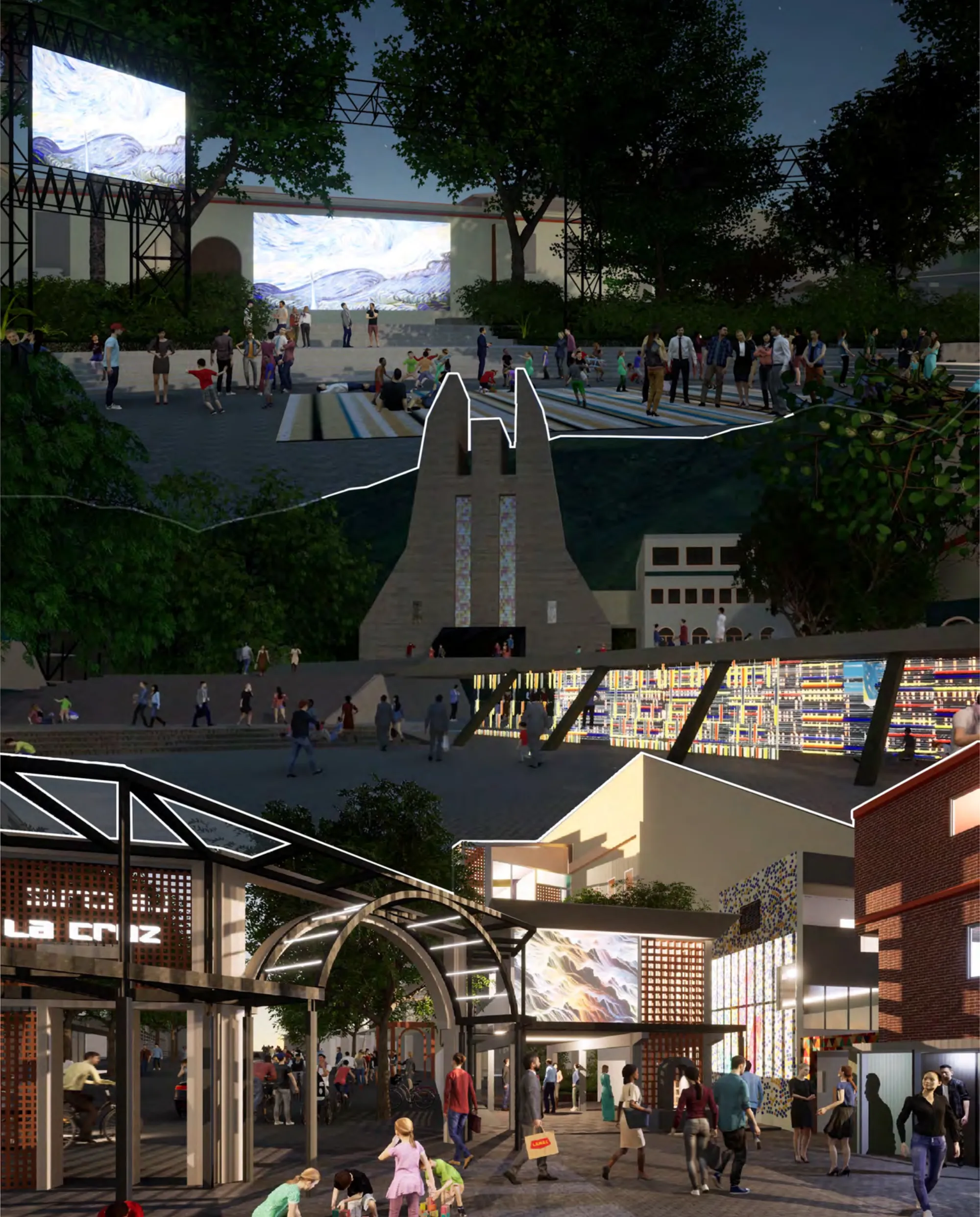
Night collage of the thesis interventions by Angelica De Bernardo: an open-air screen glowing against the dark silhouette of El Ávila over the stepped plaza of Altamira and the twin towers of Don Bosco church, the illuminated colorful facades of Chacao's continuous gallery, and the arched entrance of La Cruz where people stroll under the new lattice canopy.

Public space is an urban concept, a changing and transformable entity that acts as a reflection of the society that inhabits and defines it. Shaped, therefore, by the character of the urban space and its relationship with contained areas; it is in the sense of limit, relation and transition established between the exterior and the interior where the essence of a place — its locus — is ultimately defined.

Configured by the urban borders that shape and distinguish the public areas of a city, the solid-void relationship of the urban condition relies, fundamentally, on the façade. As the urban and architectural element that defines and relates two conditions, the façade, as a boundary, “… is not that at which something stops, but (…) that from which something begins its presencing” (Heidegger M., 1951, Building, Dwelling, Thinking).

This project researches, explores and categorizes the types of interplay between the urban condition, the public sphere and the facade as the reflection of a city’s identity; focusing on Caracas, a “city composed of cities” (Cardona I., 2003, Caracas, Ciudad “Formal” vs ciudad “Alterna”) where multiple urban conditions meet and different categories of public spaces coexist.

As a final degree project, this work was conceived as both a theoretical and projective investigation. This portfolio summarizes and seeks to encapsulate the main points of the research, as well as show the architectural explorations that developed from it.
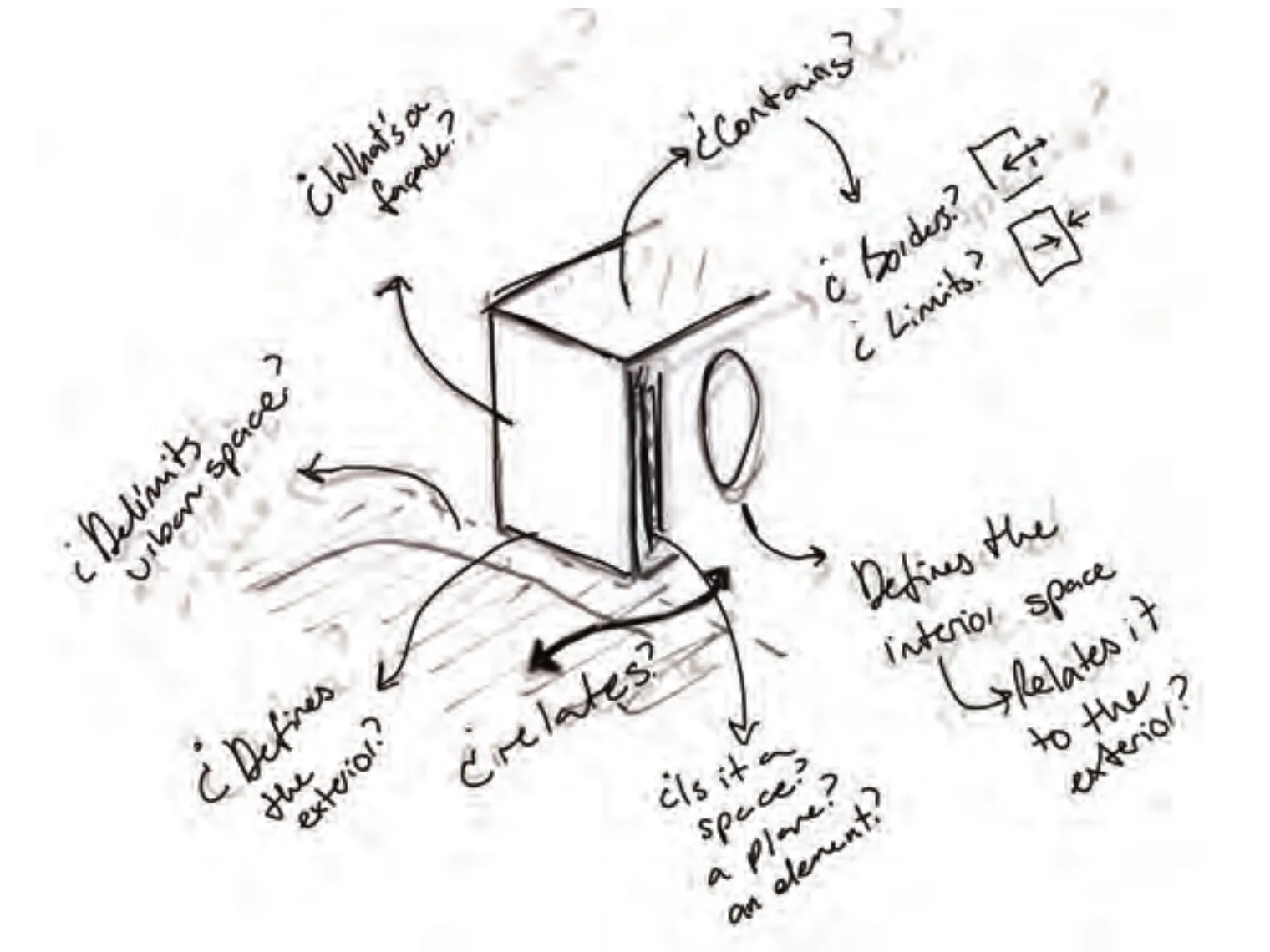
Hand-drawn conceptual sketch of the façade as a box-like volume, surrounded by manuscript questions and arrows: what's on top?, contains?, borders?, limits?, delimits inner space?, defines the exterior?, relates?, defines the interior space — relates it to the exterior?, and is it a space, a plane, an element?
CONCEPT SKETCH — QUESTIONING THE FACADE ¿is it a space? ¿a plane? ¿an element?

INHABITING FACADES — undergraduate thesis video

URBANITY AND PUBLIC SPHERES | SOCIETY AND URBAN SPACES

As a reflection of the culture and society that dwells within a particular time and place, urban spaces are defined by the public-private interplay that’s conditioned by the beliefs, activities and needs of city inhabitants. This results in particular exterior-interior relationships that, reflected by the urban borders, are consolidated into a city’s identity.
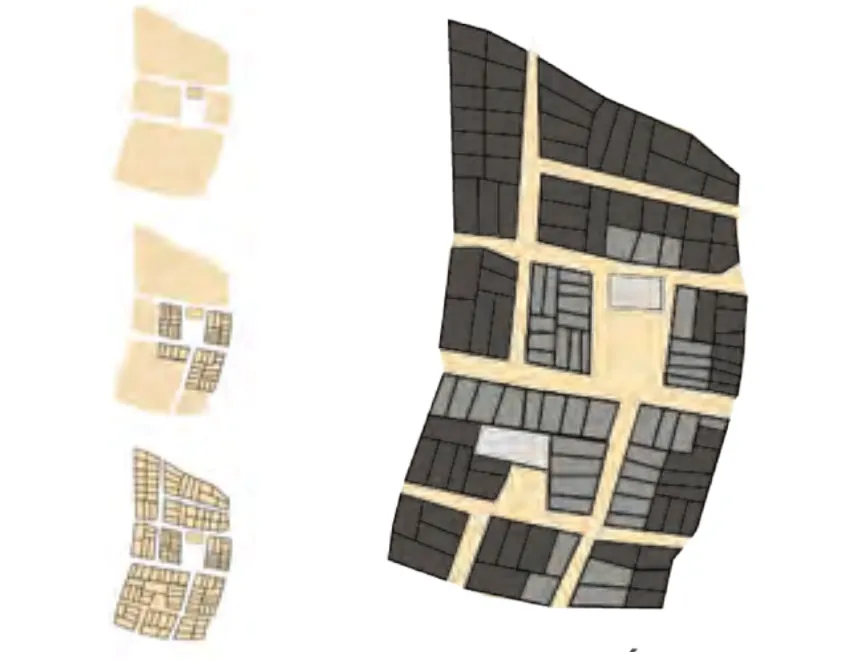
Watercolor figure-ground of the public city: the colonial fabric drawn as dark roofs over sand-toned streets, with three evolution stages from solid blocks to a fine-grained grid.
PUBLIC CITY public to private layout
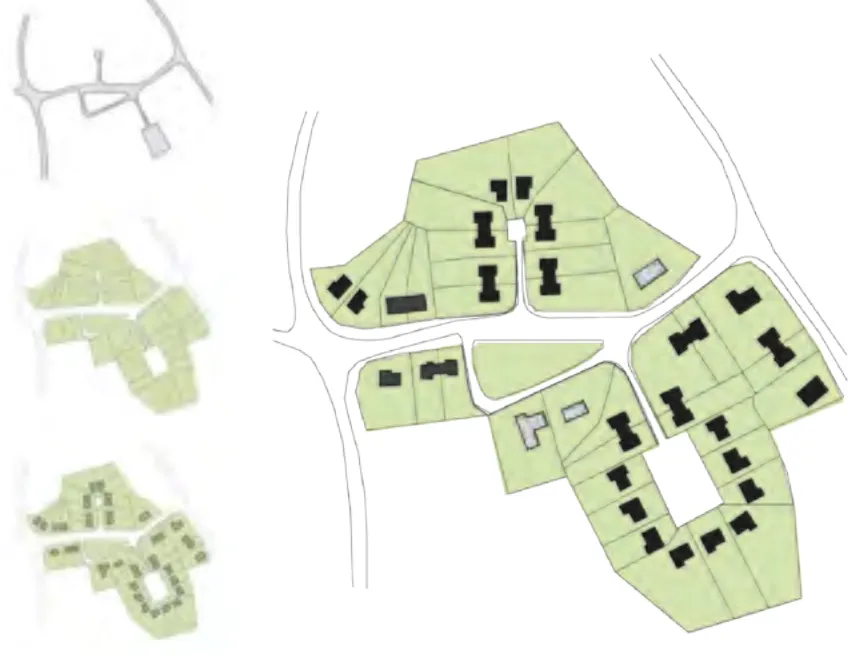
Watercolor figure-ground of the dispersed city: detached buildings on green garden plots along curving roads, with the street network and two evolution stages beside the final plan.
DISPERSED CITY link-centric urbanity
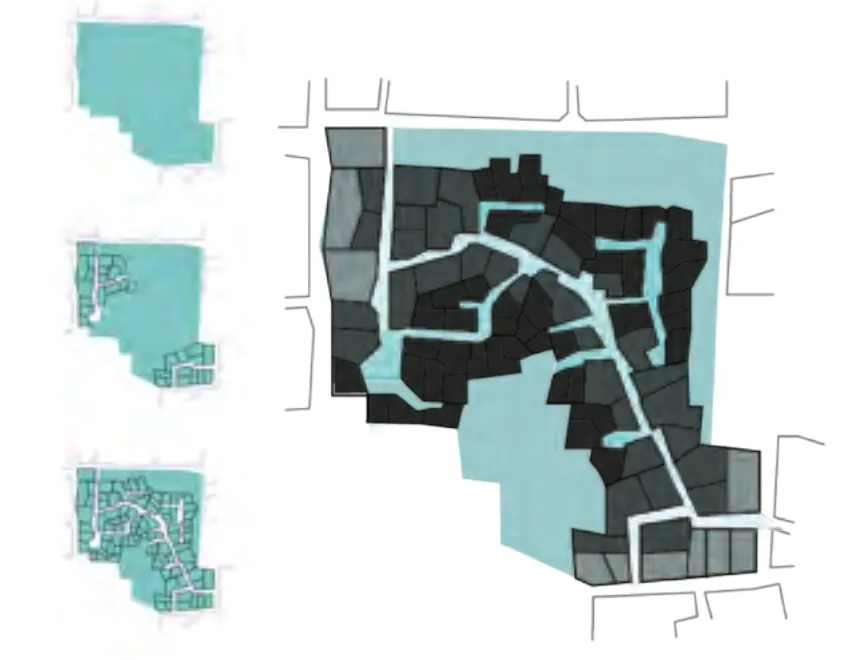
Watercolor figure-ground of the private city: the informal fabric growing over a teal superblock in three stages, from open land to a dense self-built patchwork threaded by walkways.
PRIVATE CITY private to public growth

Shaped by their evolution and cultural ideologies, the different dwelling conceptions form particular urban layouts and spatial configurations. In Caracas, these categories coincide, creating a heterogeneous patchwork with multiple urban identities that reflect the city’s history.

Three maps of Caracas strung on a single line, each highlighting one city category over the grey urban fabric: the colonial city in orange, the garden city in olive green and the informal city in teal, with small figure-ground icons beside each label.
CITY CATEGORIES AND THE HETEROGENEOUS CITY colonial city · garden city · informal city

Composed and characterized by its urban borders — by its façades — the locus of a place resides in, and is defined by, the public space. Reflected not only morphologically, but also in the sense of place and the definition of their public spaces; the particular identity of the different urban conditions of Caracas is explored through the lens of Chacao, a sector of the city that collects the different urban categories within its territory.
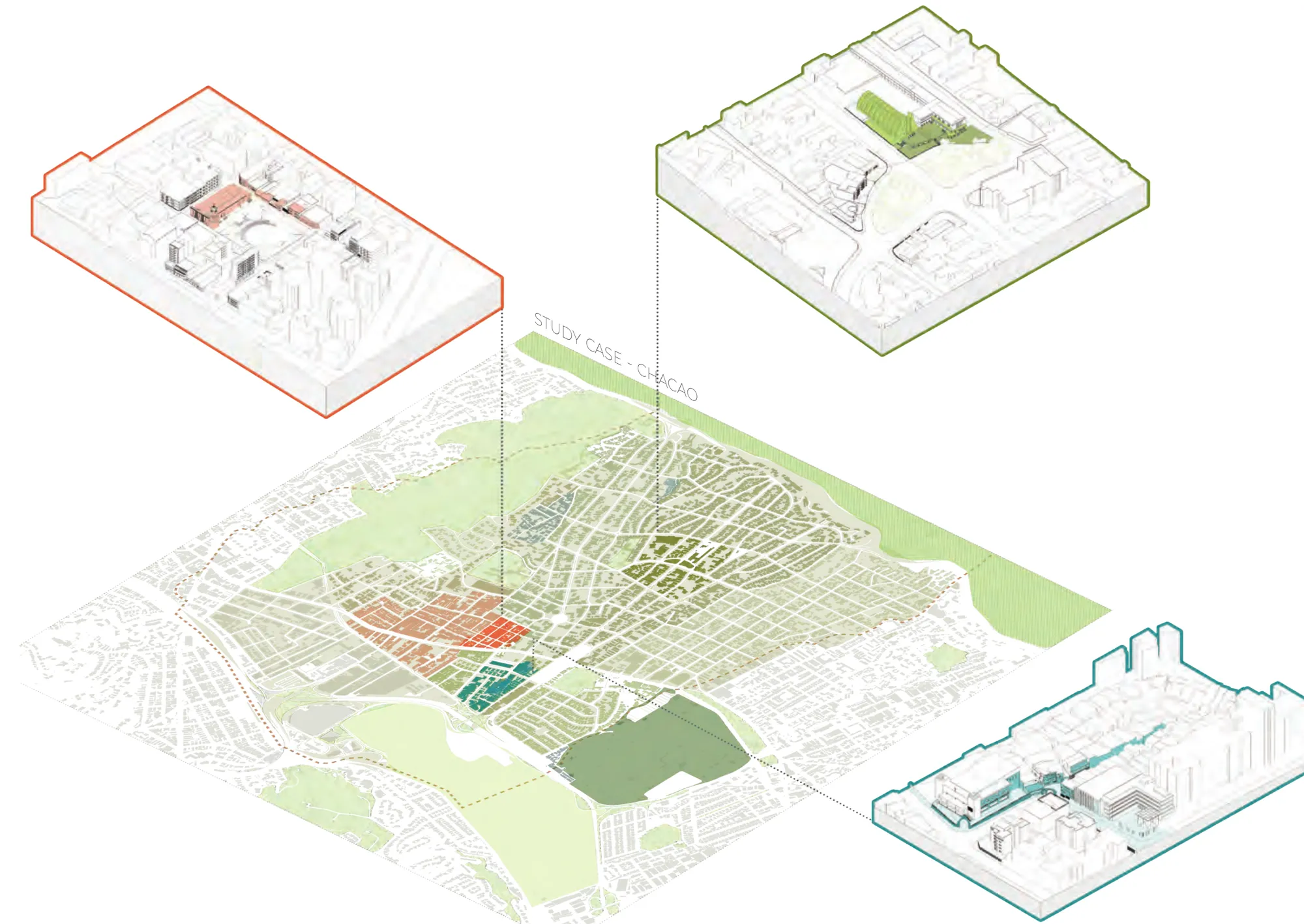
Axonometric of the Chacao study case: the sector map drawn in pastel greens with the colonial grid highlighted in salmon and teal, linked by leader lines to three colored block samples — the public city in salmon, the dispersed city in green and the private city in teal — along the dashed label study case Chacao.
STUDY CASE — CHACAO the public, dispersed and private city within one territory

INTERSTICE, BORDER AND LIMIT | FACADE TYPOLOGIES

The different solid-void, exterior-interior relationships found in Caracas are reflected in the particularity of the case studies. Stemming from their own evolution, these public spaces define a summary of the urban dynamics and characteristics that result from the specific city categories.

Historical timeline weaving three strands: the 1768 founding of San José de Chacao with its 1900s main square photographs, Altamira's 1943 founding with the 1950s transformation and Don Bosco chapel and temple, and La Cruz's 1954 founding with 1960s aerial views and El Buen Pastor church.
EVOLUTION OF THE CASE STUDIES 1768 founding of San José de Chacao · 1943 Altamira's founding · 1954 La Cruz founding
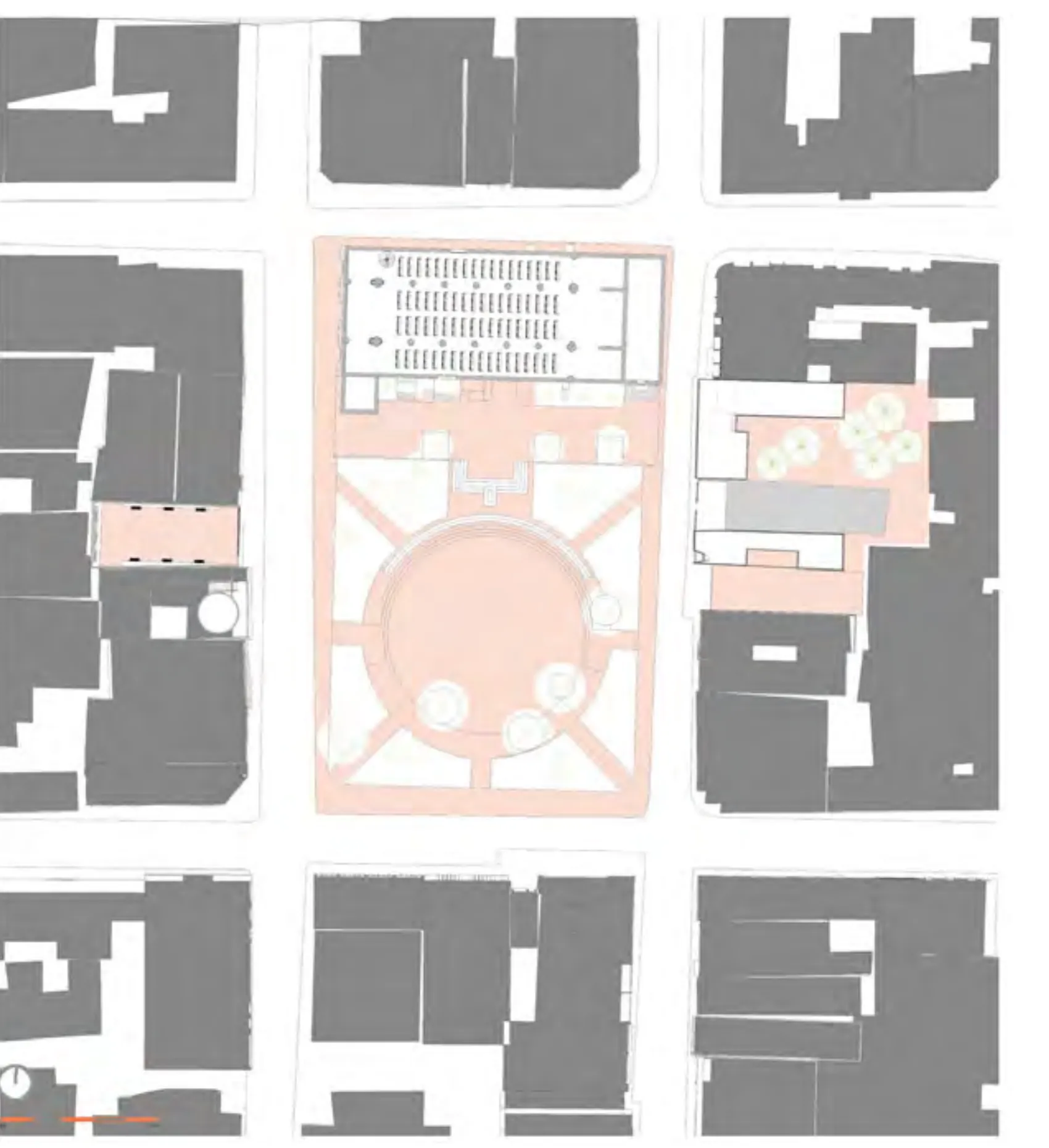
Figure-ground plan of Bolívar's square in Chacao: the rectangular plaza washed in salmon with its circular center and market hall, framed by the dense colonial blocks in grey.
BOLÍVAR'S SQUARE chacao's colonial center — edified border
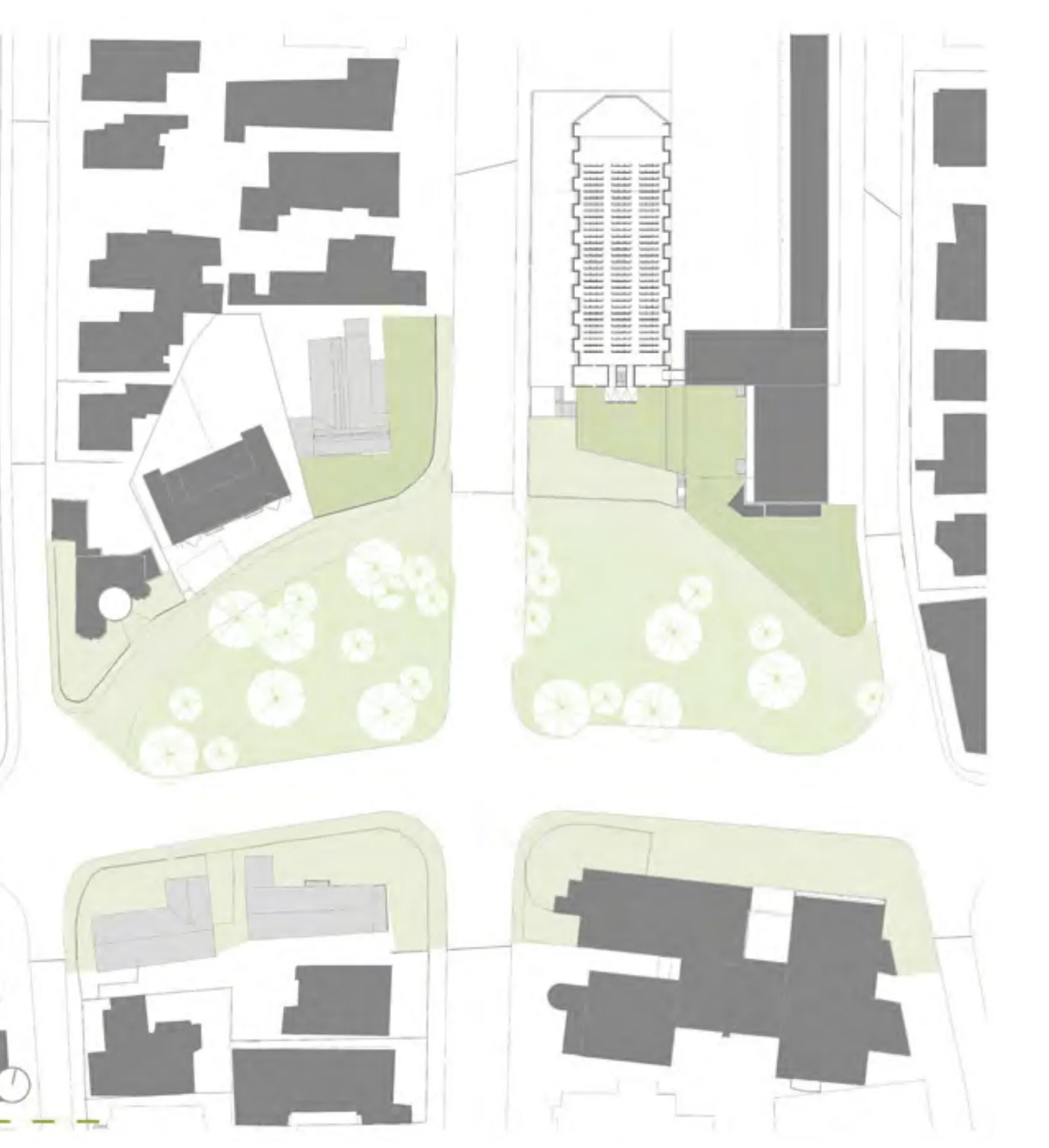
Figure-ground plan of Don Bosco's twin plazas in Altamira: two tree-dotted green gardens flanking the avenue, between the church, the tower and the garden-city blocks in grey.
DON BOSCO'S TWIN PLAZAS altamira — topographical border
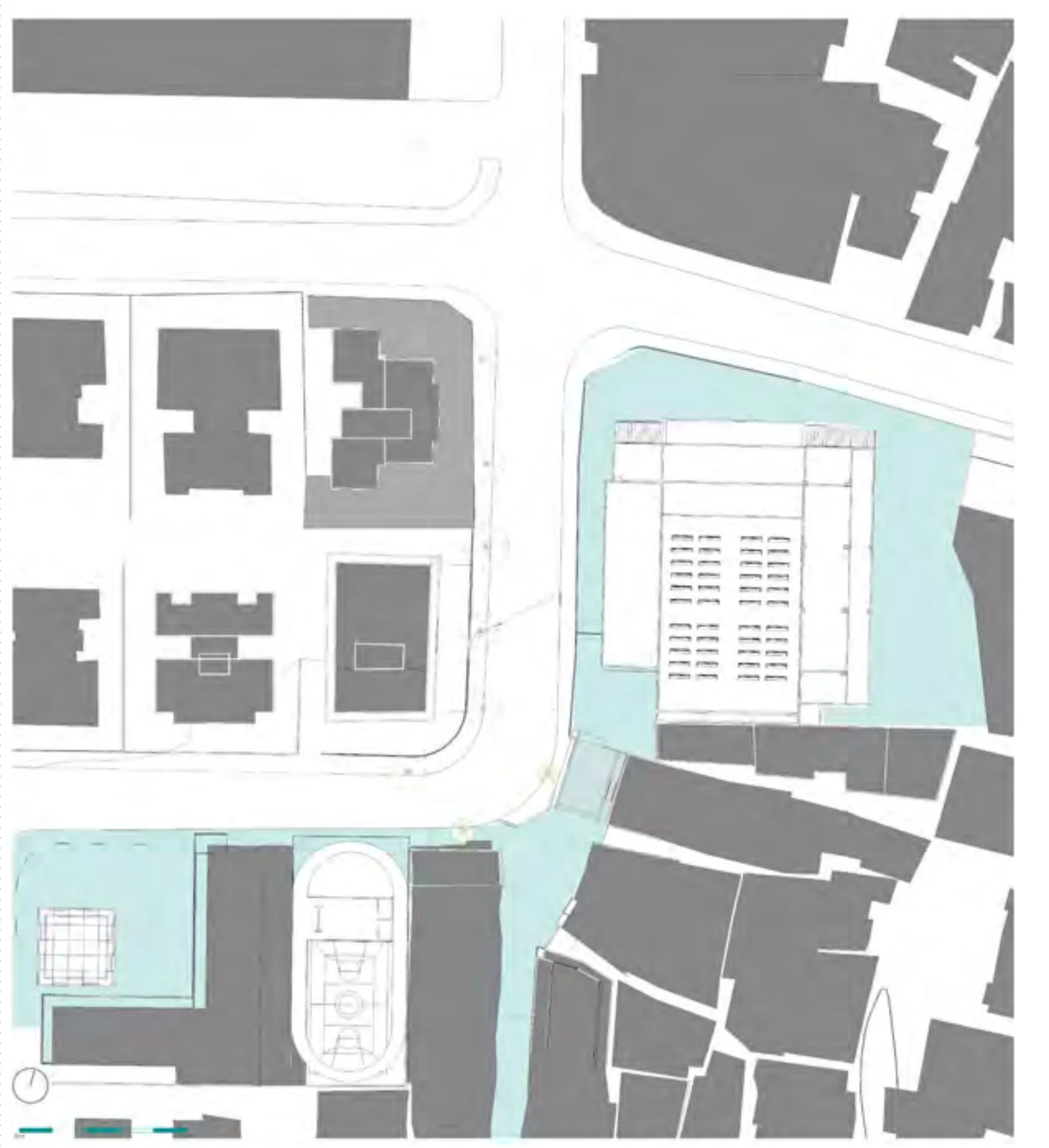
Figure-ground plan of La Cruz entrance in Bello Campo: the community's reclaimed spaces washed in teal between the formal blocks and the informal fabric, with the sports court at the lower edge.
LA CRUZ ENTRANCE bello campo — built border

As both the defining character of the built component and the urban border that reflects the essence of public space, the value and duality of the façade as a reflection of the site’s identity is explored through the typological varieties defined according to the spatial condition of the facade.
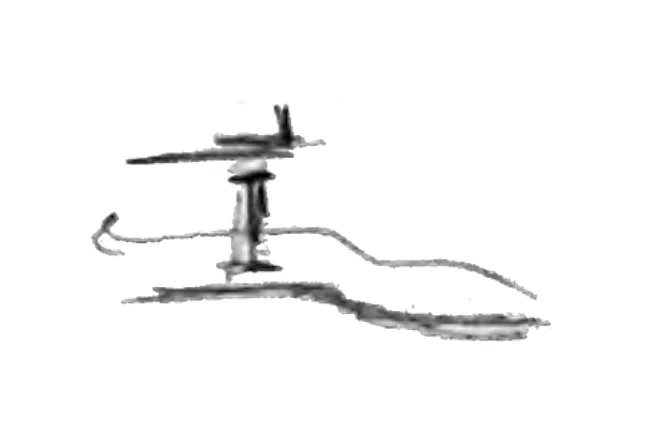
Ink sketch of the interstice: repeated vertical elements between two horizontal planes, with an arrow weaving through the gap.
THE INTERSTICE by element repetition
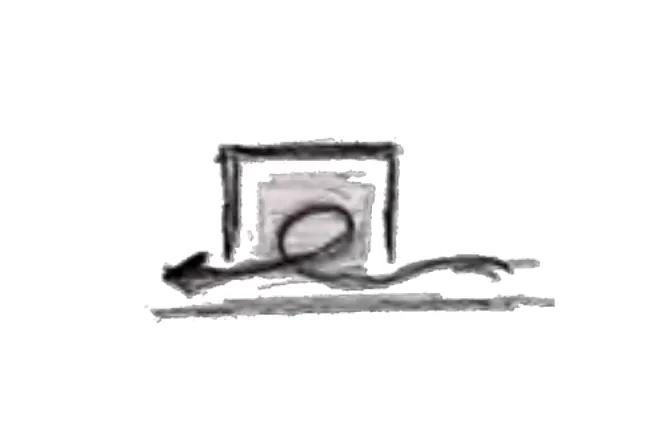
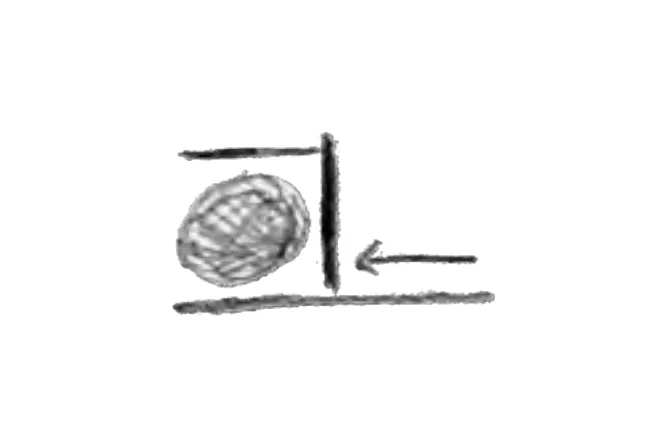
Ink sketch of the limit: a hatched mass pressed against a thick vertical surface, with an arrow stopping at the wall.
THE LIMIT a stereotomic surface
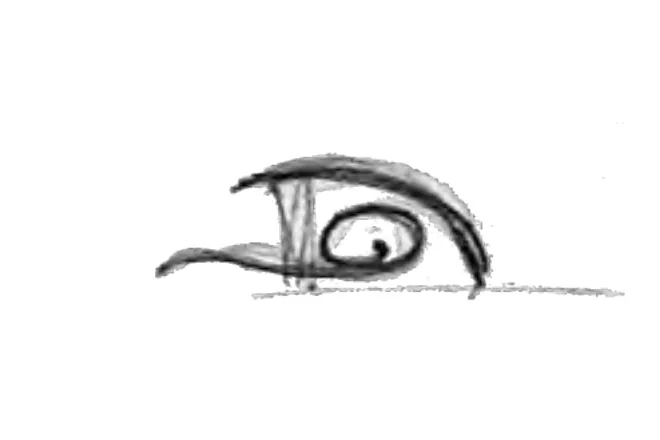
Ink sketch of the cover: a continuous shell curling over the interior space like a wave above the ground line.
THE COVER a continuous shell
Ink sketch of the envelop: a membrane wrapping a shaded volume, with an arrow sliding beneath its edge.
THE ENVELOP a unifying membrane
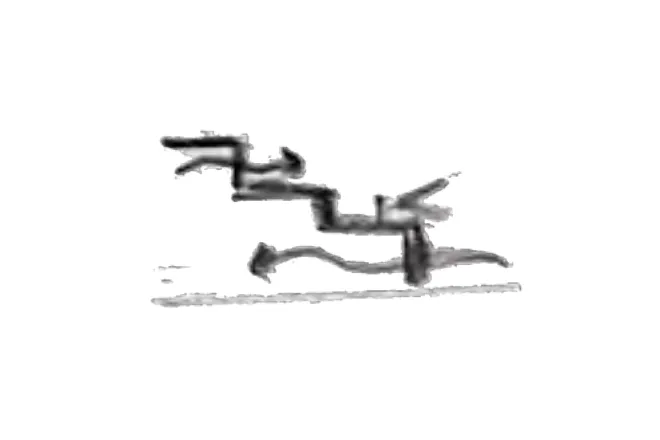
Ink sketch of the volume: terraced masses stepping down, with arrows tracing the interactions across the levels.
THE VOLUME as terraced interactions
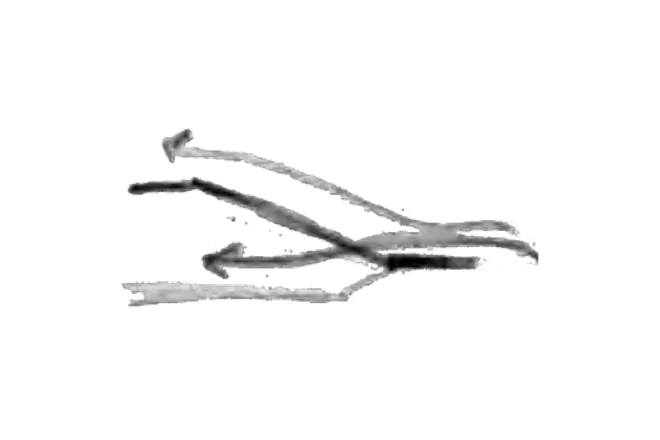
Ink sketch of the fold: overlapping surfaces branching from the ground plane, with arrows running along the walkable planes.
THE FOLD as walkable surfaces

THREE INTERVENTIONS | EXPLORING BORDER CONDITIONS

Through particular relationships between exterior and interior spaces, each intervention explores a different border condition. Thus, each intervention emphasizes the identity of the place and is defined by the context (and the solid-void relationship) into which it is inserted.

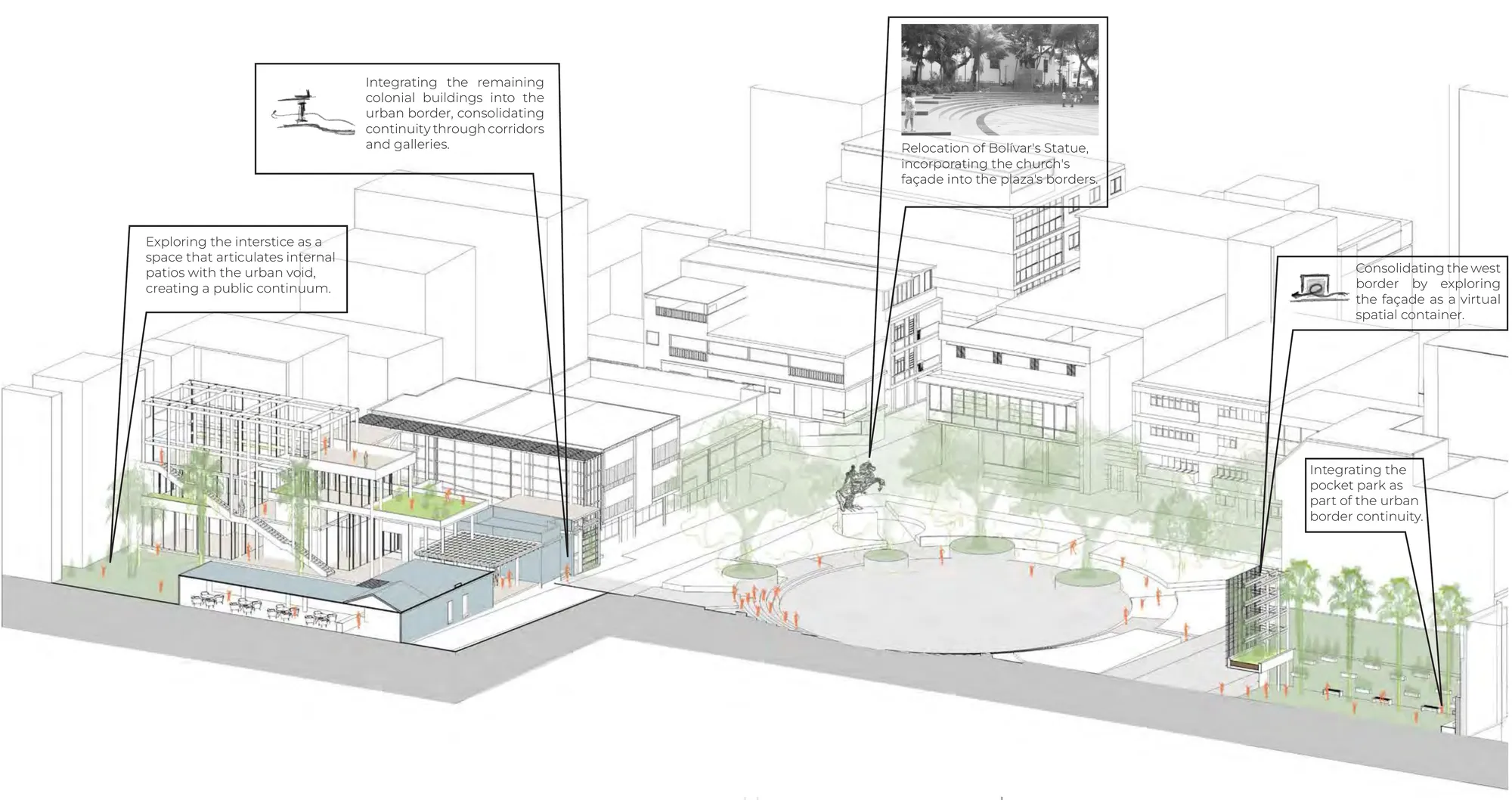
The intervention explores the interstice and the envelop as strategies that contain and articulate the existing urban voids while reinforcing the continuity of the urban border.

Annotated street elevations of Chacao's existing urban borders: the colonial church and houses, building overhangs, empty lots, chamfered corner-blocks, facade continuity, height variations and a fenced pocket park, each marked with rotated labels and section markers.
EXISTING URBAN BORDERS covered sidewalks · building overhangs · colonial houses · empty lots · chamfered corner-blocks · facade continuity · height variations · fenced pocket park
Annotated axonometric of the Chacao proposal: the circular plaza framed by corridors and galleries, new lattice volumes weaving through the remaining colonial buildings, with callout notes on the relocation of Bolívar's statue, the interstice as a public continuum, the consolidated west border and the integrated pocket park.
PROPOSED INTERVENTIONS — THE BORDER AS AN URBAN PALIMPSEST interstitial continuity · vegetation as a container · framing the plaza through contained public spaces

02 | EXTENDED GARDEN — DON BOSCO’S AV., ALTAMIRA

The proposal explores the slope, the cover and the volume as urban elements that extend the existing borders, articulating the urban space with the isolated structures that surround it.
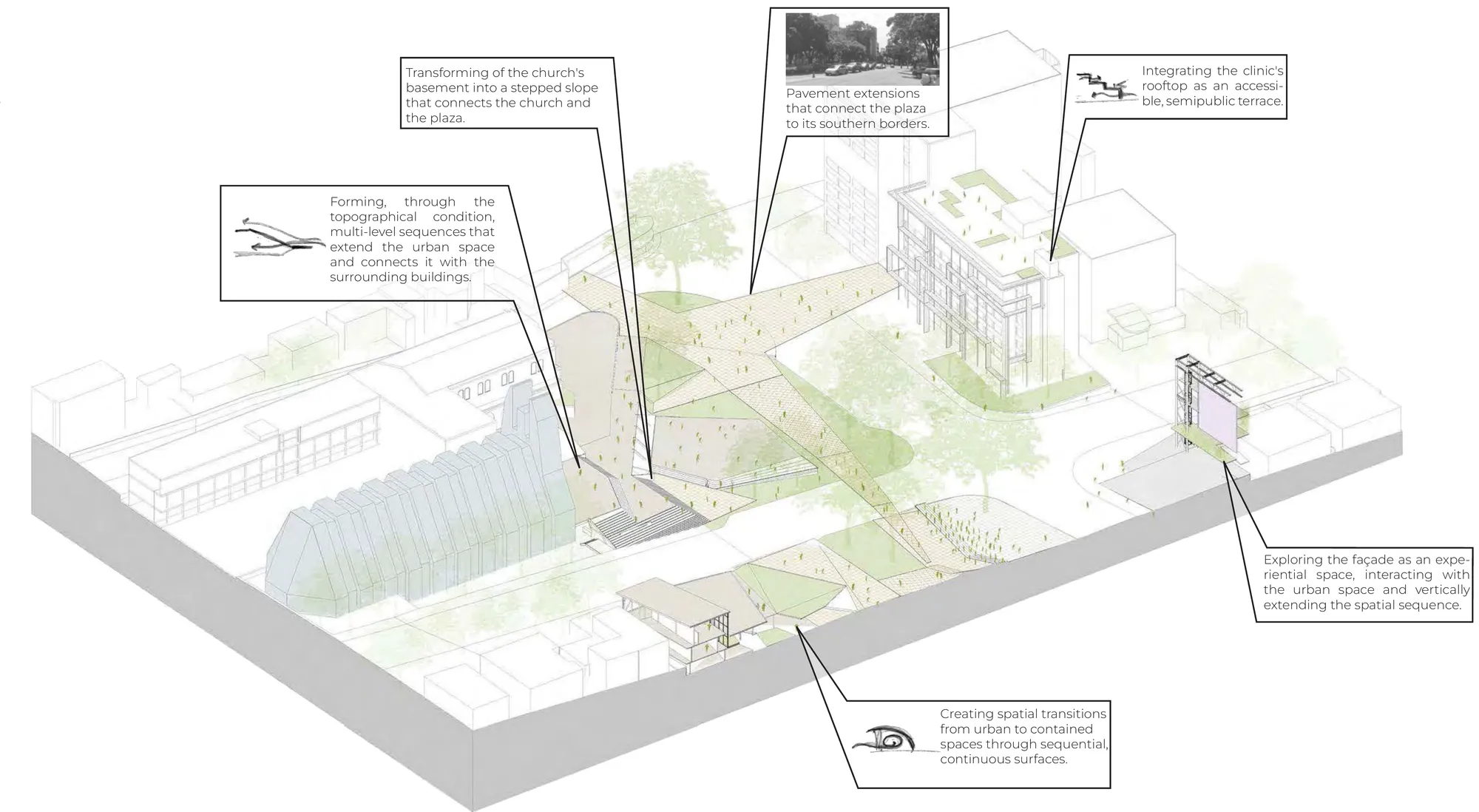
Annotated axonometric of the Altamira proposal: fan-shaped green pavements extending the twin plazas across Don Bosco avenue, a stepped slope connecting the church's basement with the plaza, the clinic's rooftop as an accessible semipublic terrace, and callouts on multi-level sequences and experiential facades.
PROPOSED INTERVENTIONS — EXTENDING THE LIMITS transitional continuity · multi-level sequences that extend the urban space
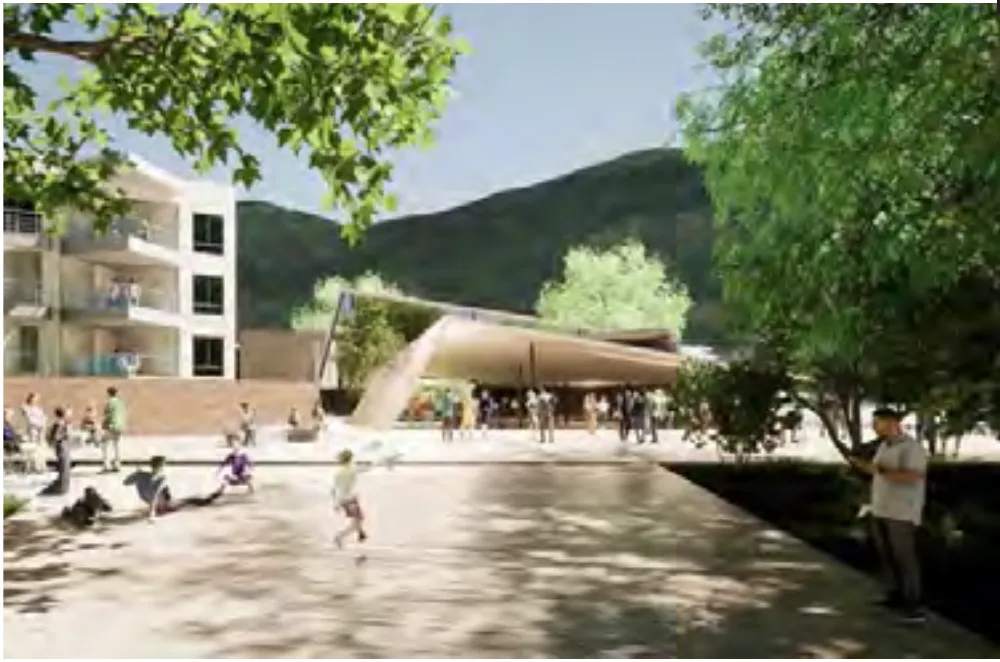
Render of the extended garden at street level: people crossing the shaded plaza among new trees, with the white canopy of the stepped slope and El Ávila mountain rising behind.
FROM THE PLAZA TO EL ÁVILA border transitions that extend towards the mountain

03 | DEFINING ARCHES — LA CRUZ, BELLO CAMPO

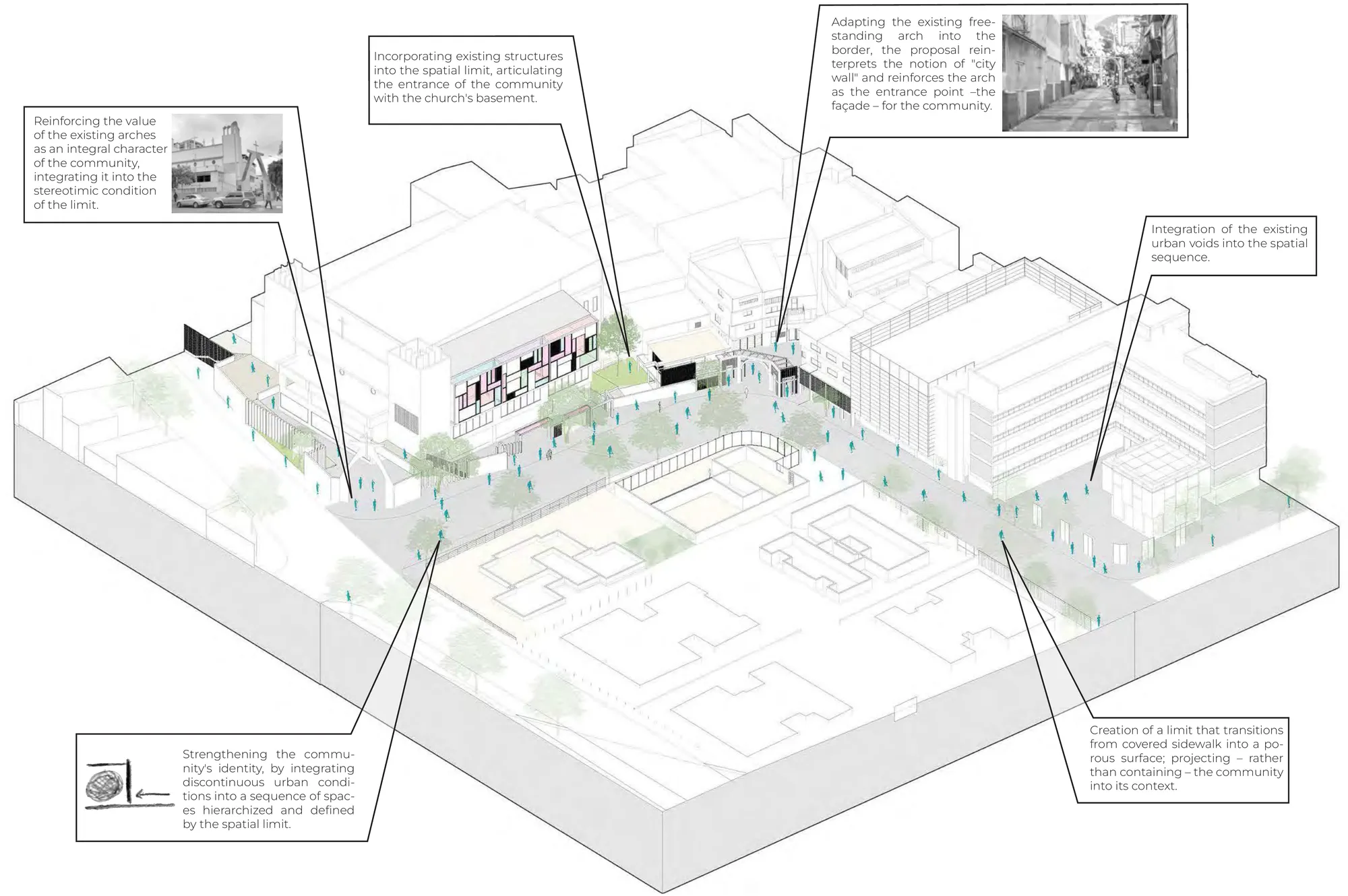
The explorations focus on the surface as an independent, detached component that defines the limit of the community and serves as its façade towards the rest of the city.
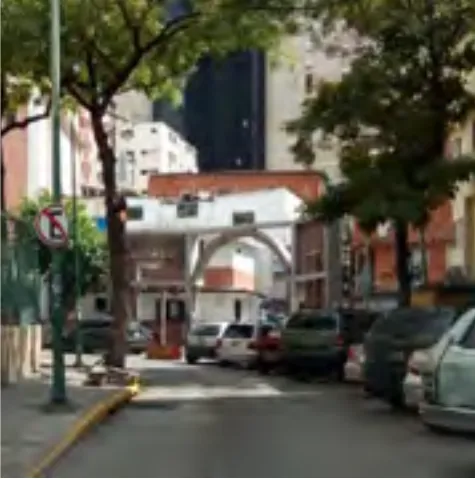
Photograph of the existing white arch spanning the street at La Cruz entrance, framed by trees, parked cars and the towers of Caracas behind.
THE EXISTING ARCH la cruz entrance — bello campo
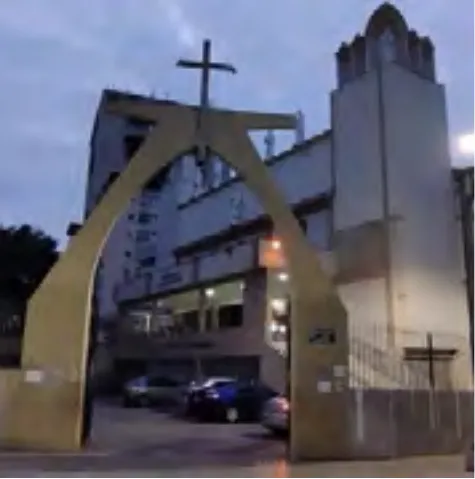
Photograph of El Buen Pastor church at dusk: the freestanding yellow arch crowned by a cross, standing before the bell tower and the parish gate.
EL BUEN PASTOR CHURCH the arches as an integral character of the community
Annotated axonometric of the La Cruz proposal: the community border drawn as a sequence of arches and porous screens around the reclaimed block, with callouts on adapting the existing freestanding arch, integrating existing structures and urban voids, and the limit transitioning from covered sidewalk into a porous surface that projects the community into its context.
PROPOSED INTERVENTIONS — DISCONTINUOUS SURFACE spatial sequentiality · the arch as the entrance point — the façade — for the community

The imaginary of a city tends to be strongly linked to the urban void present in it. In Caracas, these urban voids are defined within distinct urban patches, resulting in a diverse reading of the city. Directly linked to the concepts of boundary, limit and border, the façade is a duality where two realities coincide; differentiating and shaping one another.
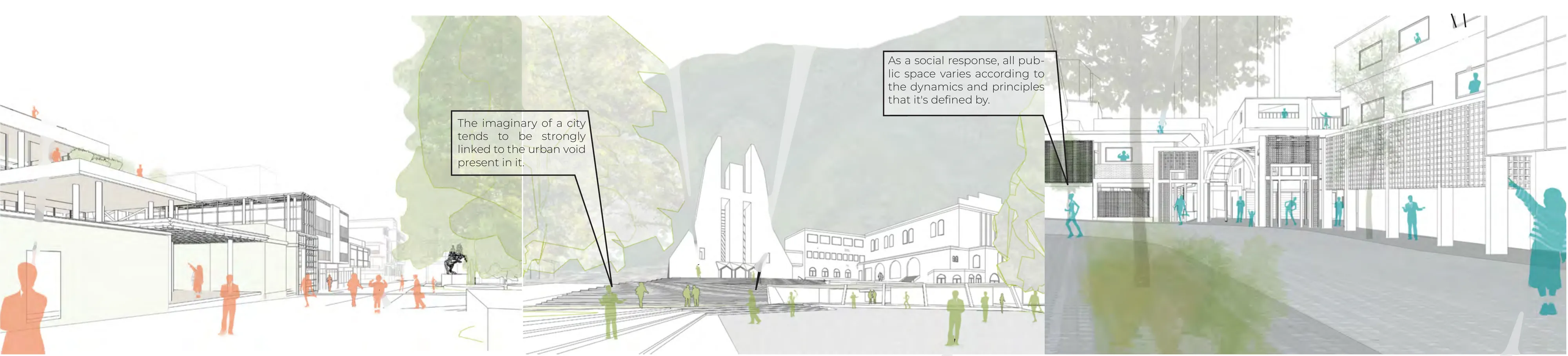
Continuous panoramic collage of the three plazas: the gallery street in Chacao with coral silhouettes, the twin plazas of Altamira against El Ávila with Don Bosco church, and the arched border of La Cruz with teal figures, annotated with notes on the urban void and public space.
THE THREE INTERVENTIONS continuous gallery · extended garden · defining arches

To speak of the façade is to speak of associations and interpretations that, like the urban patches that define a city, are composed and shaped as a reflection of our understanding of the world and, in turn, as an opportunity to engage with it.