MODULAR HOUSING | social housing | industrialized prototype
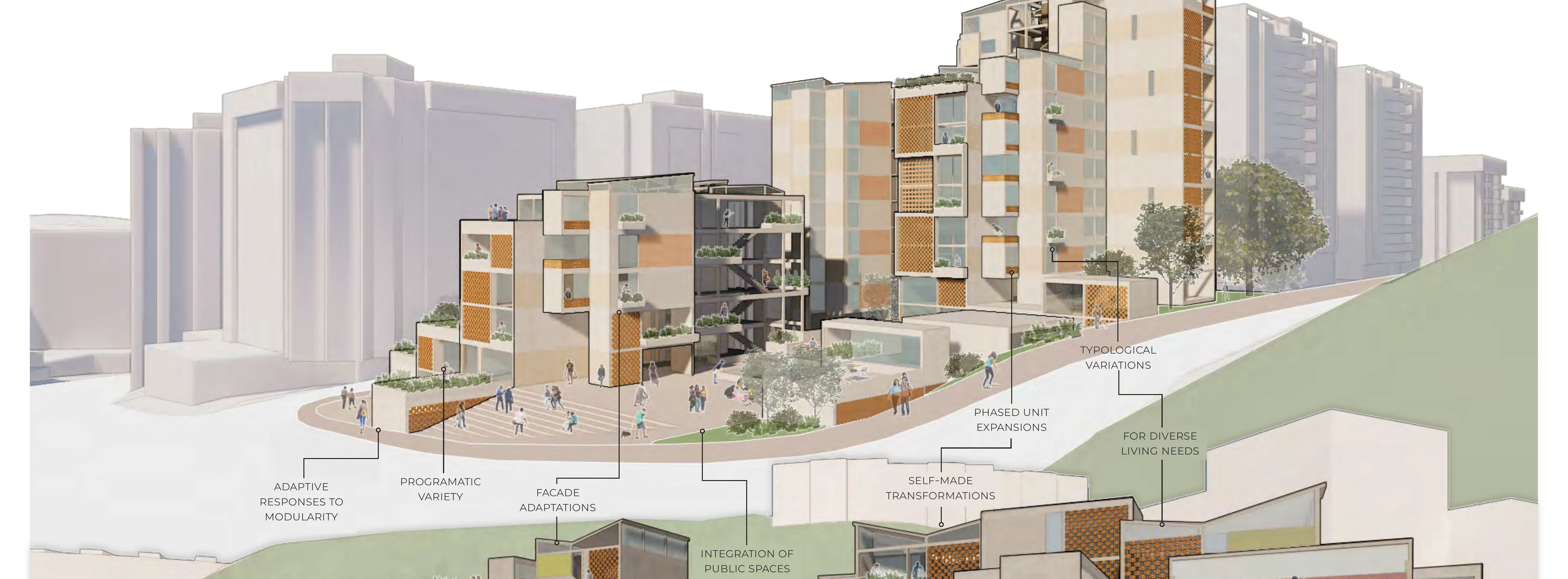
Stemming from the structural principles established by Alejandro Restrepo in his proposed modular housing system, the project centers on the development and testing of a viable, industrialized housing solution.
By delving into the prototyping of a prefabricated and easily assembled structural system, the project explores design flexibility and replicability within the constraints of modularity, aiming towards the development of context-responsive, site-particular building adaptations.
INDUSTRIALIZE | INDIVIDUALIZE | TRANSFORM
The process moves from module explorations to system definition and site-based adaptations, pursuing three aims: industrialize — develop a flexible module and a system prototype; individualize — allow for unit expansions, variety and personalization; and transform — make the system adaptable to different conditions: context-responsive housing solutions.
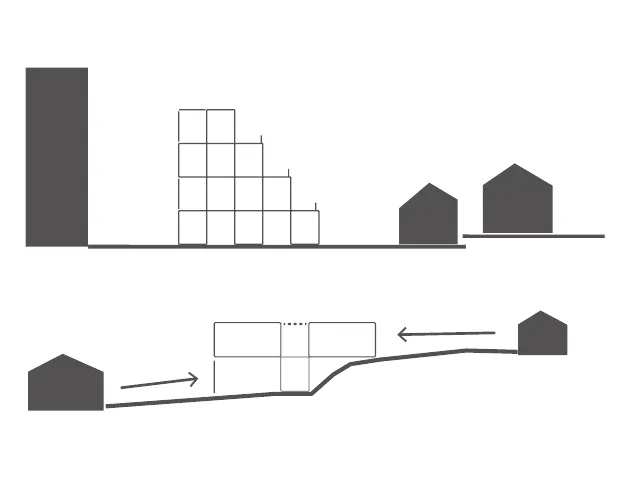
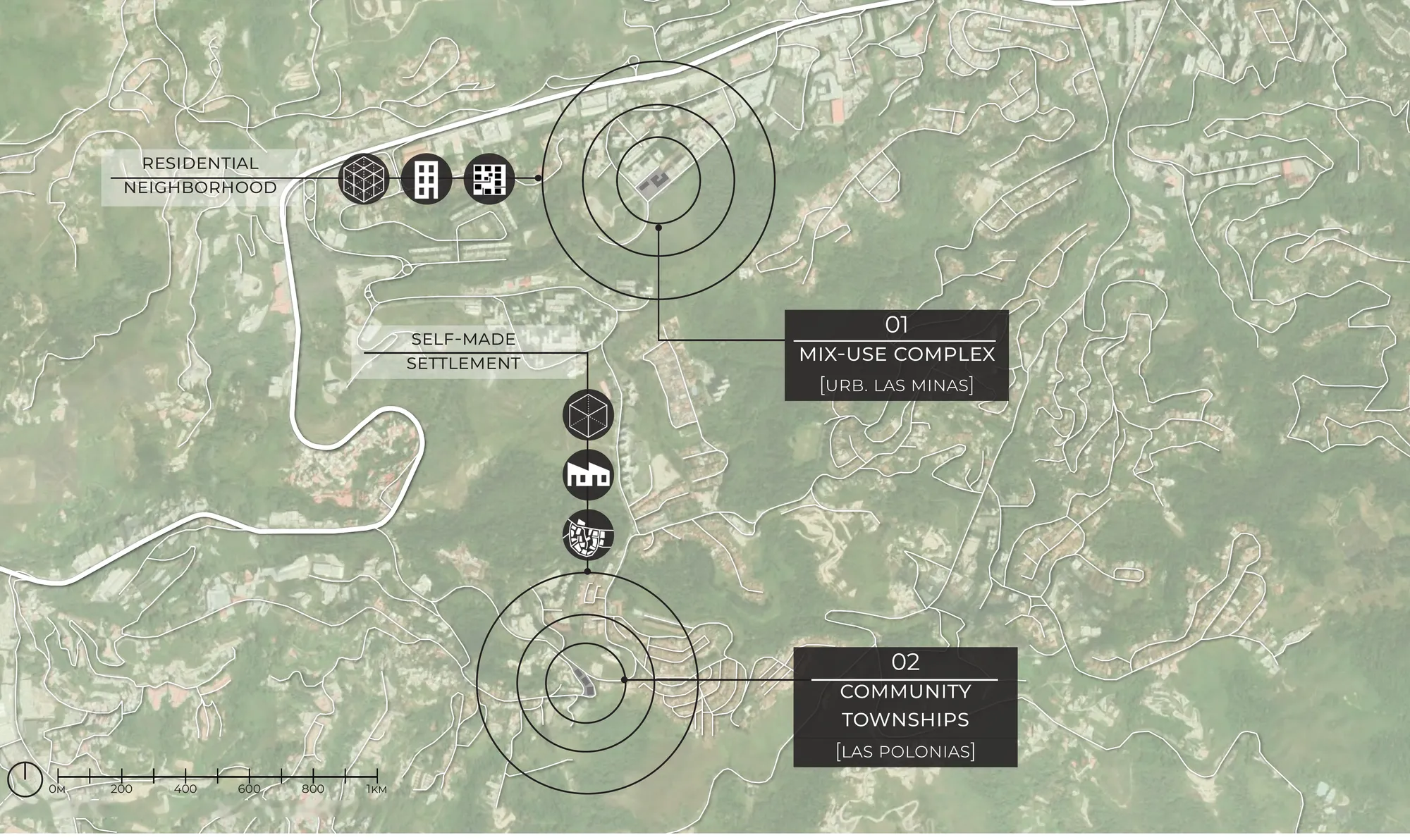
Two contrasting sites within San Antonio de los Altos serve as testing grounds for the prototype: a mixed-use complex in Urb. Las Minas, next to a consolidated residential neighborhood, and community townships in Las Polonias, alongside a self-made settlement.
THE SYSTEM
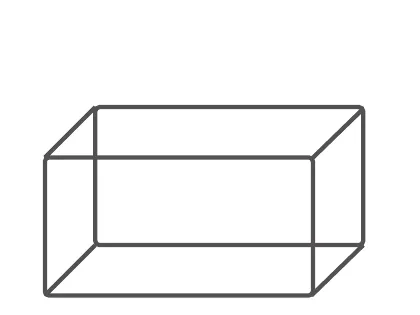
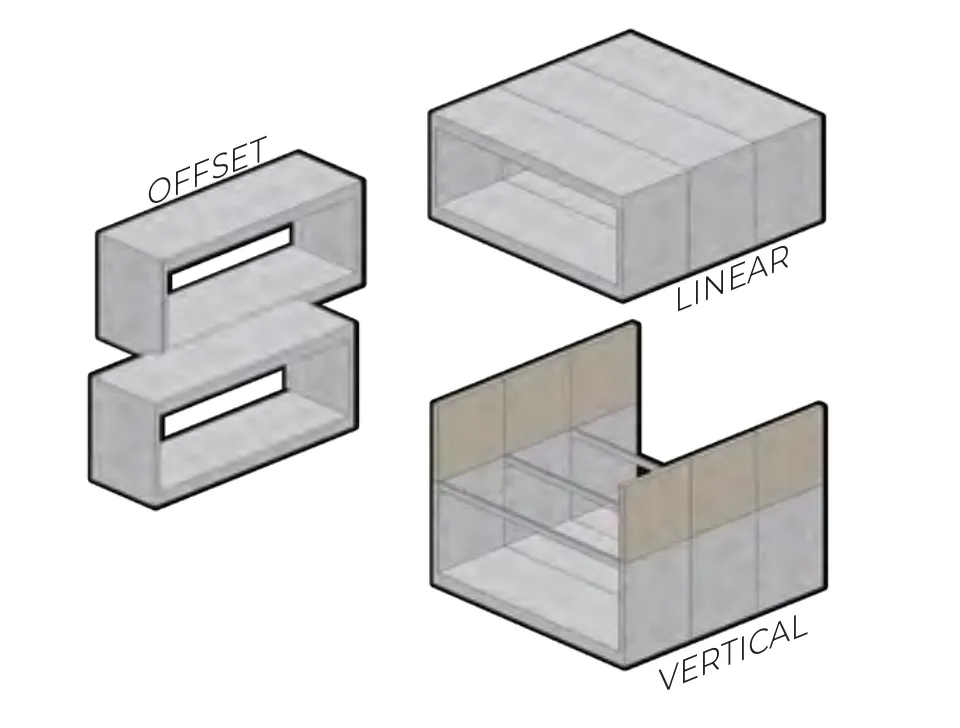
The system definition starts from a module with minimal dimensions — a 3:1 concrete frame of 7.80 × 2.60 × 3.20 meters — that can be used by itself or combined into other housing types; allowing building variations, mixed housing types and diverse assembly combinations.
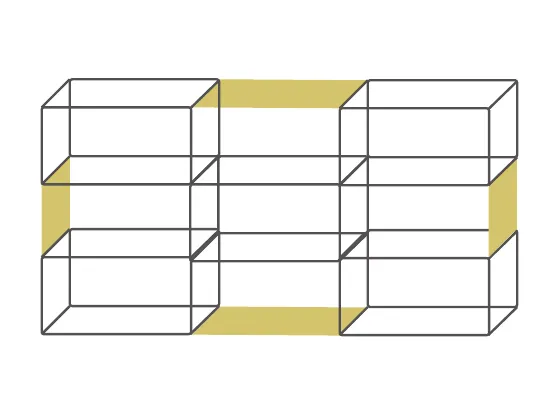
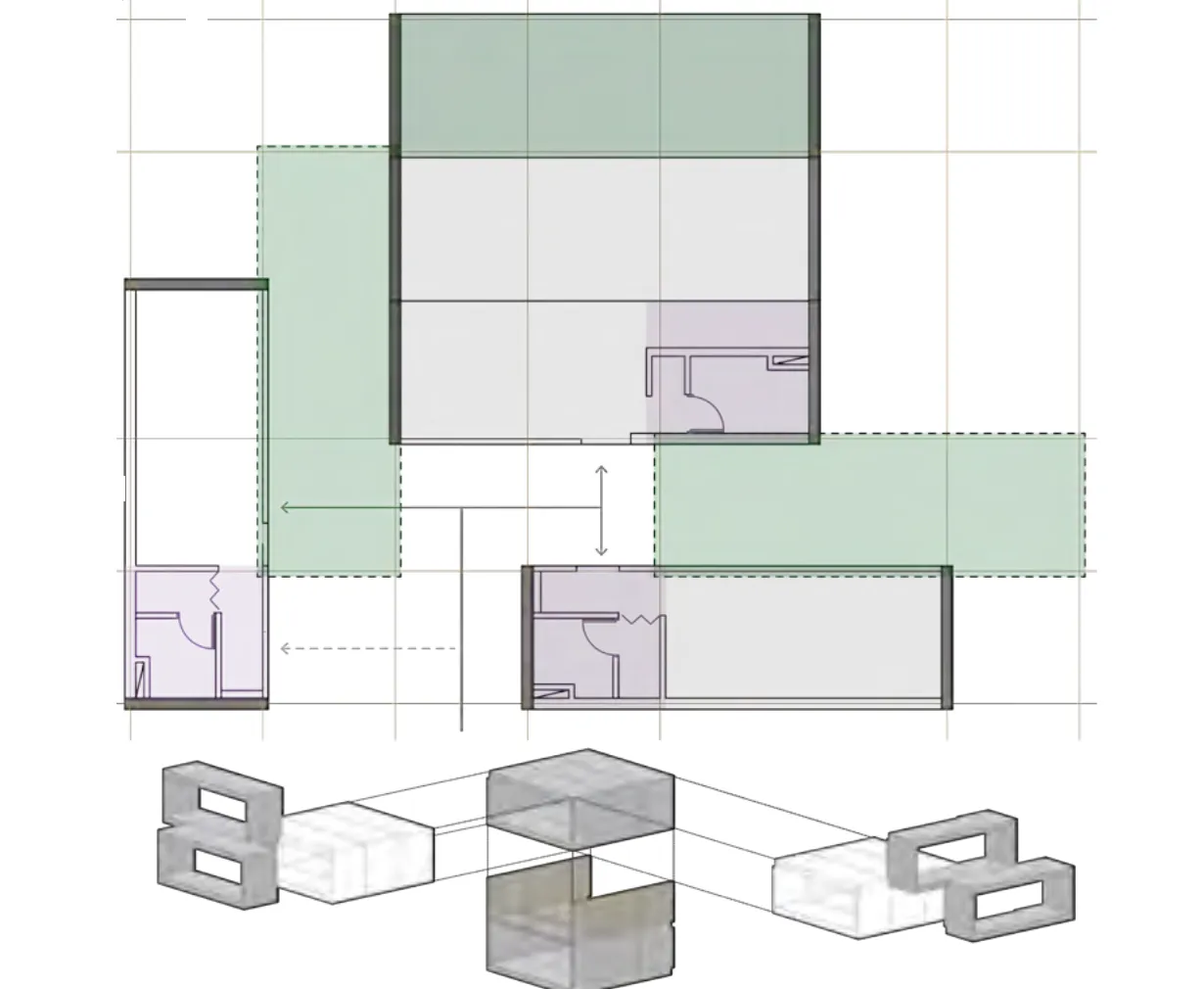
Offset and linear conditions were defined based on the 3:1 frame, creating diversity within the composition as well as varied unit configurations; and both basic parallel and perpendicular unions are defined within the proposed system, allowing directional changes within the system prototype.
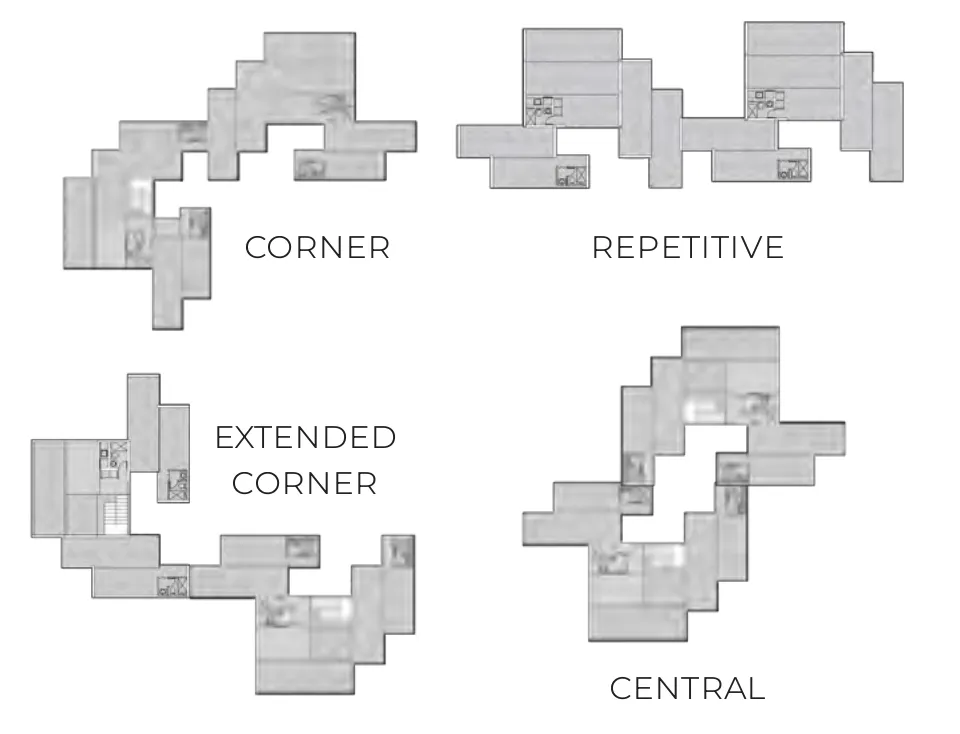
The modular compositions give maximum prototype flexibility, defining the units as components of a replicable and expandable prototype cluster; clusters that can be interconnected, replicated, or separated into their components in order to respond to building needs.
SYSTEM FLEXIBILITY
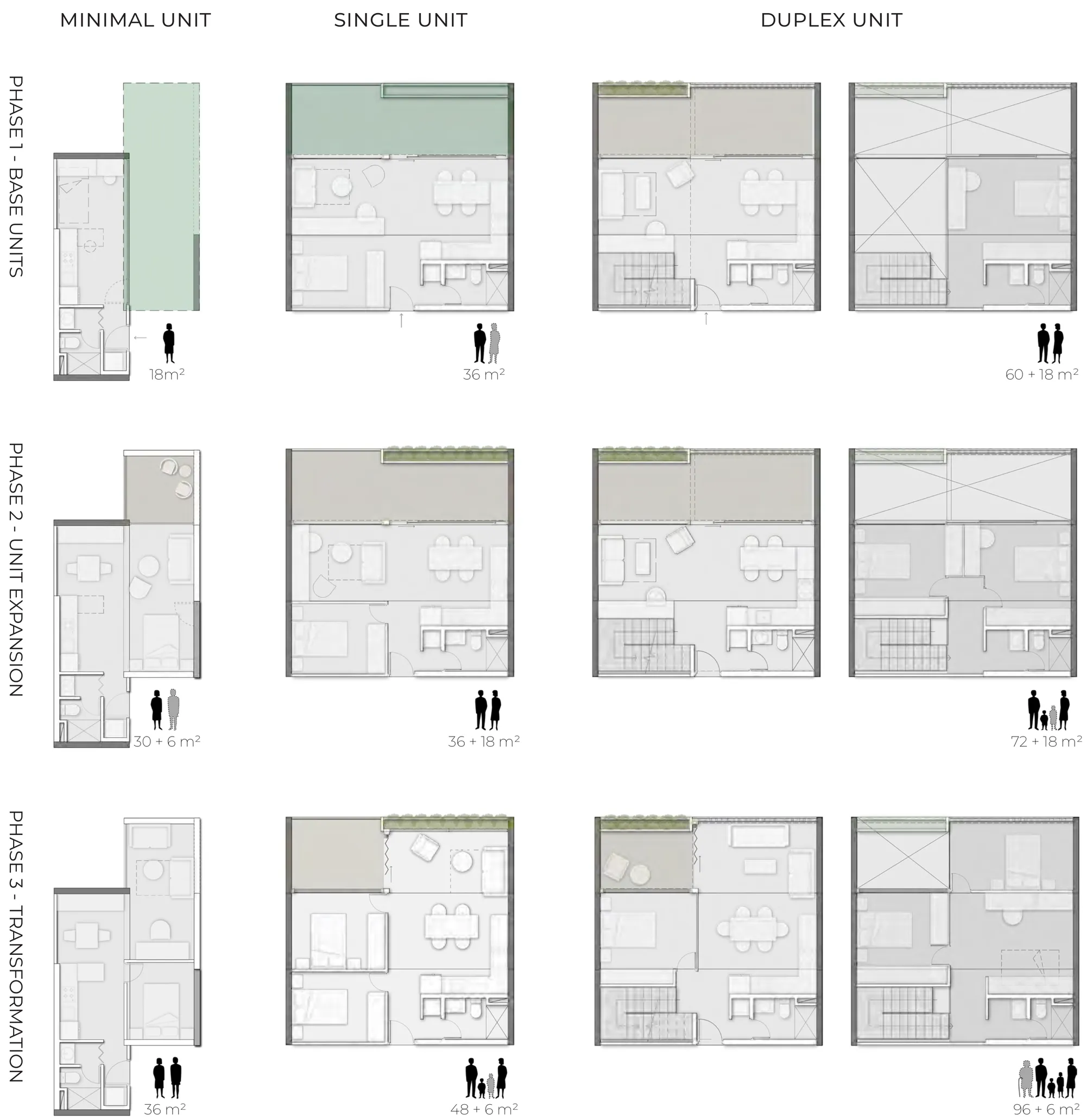
The housing units consider diverse living needs, progressive incrementality and typological variability; starting from base units that take advantage of the fill-void constructive system to expand either horizontally or vertically according to the prototype cluster.
Three typologies — minimal, single and duplex units — develop over three phases: base units of 18, 36 and 60+18 m²; unit expansions of 30+6, 36+18 and 72+18 m²; and transformations reaching 36, 48+6 and 96+6 m².
SITE ADAPTATIONS
The second phase tests the system’s adaptability and its potential to provide context-based solutions in contrasting, real-life urban conditions; reading each site through its urban morphology, topographic conditions, building typology and complex density.
01 | MIXED-USE APARTMENT COMPLEX
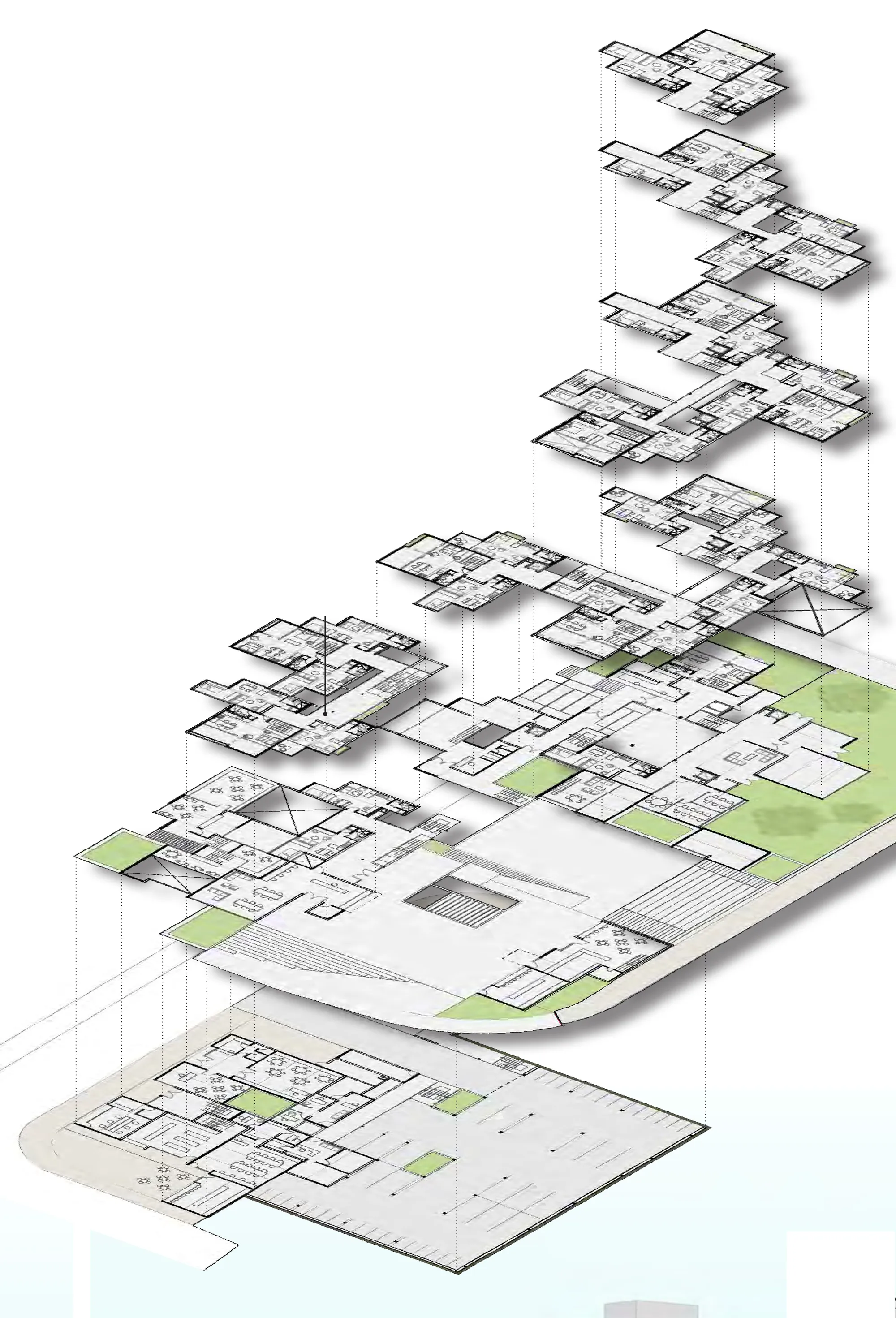
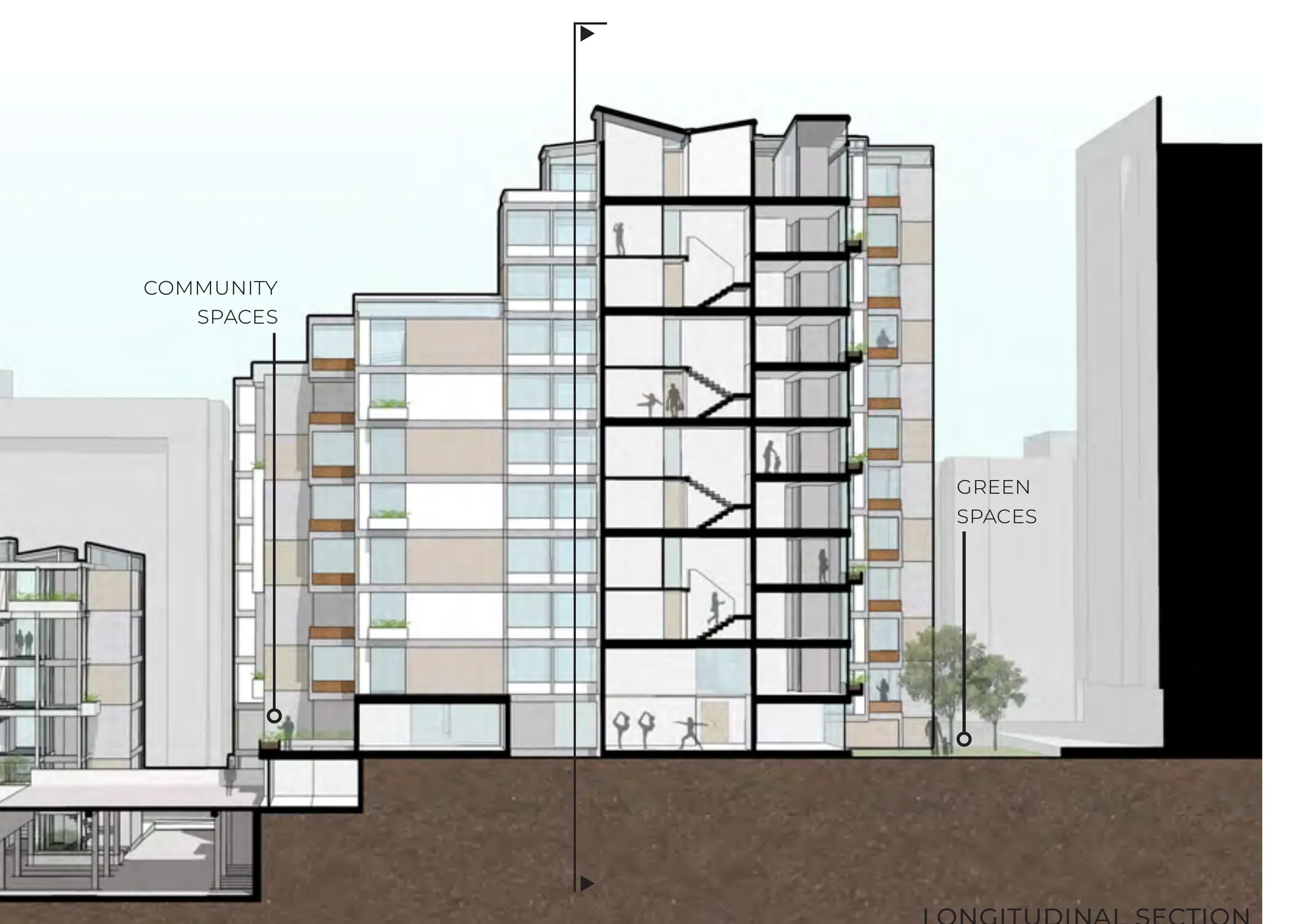
A formal neighborhood on a shallow slope: a mid-rise complex of 4,346 m² and 120 units. Located in a community already equipped with public infrastructure, the proposal reimagines the typical, strictly residential complex whilst exploring the prototype’s possibilities; integrating public spaces and programmatic variety within the housing complex.
Apartment units and common terraces rise over commercial spaces and public amenities, gathered around a multi-level civic plaza with green spaces, community spaces and a parking basement.
02 | COMMUNITY TOWNSHIPS
An unplanned settlement on a steep slope: linear terraced blocks of 2,270 m² and 20 units. Situated on a self-developed settlement in the outskirts of town, the proposal rests on the steep slope that separates the community from the main road artery of the sector.
Based on these conditions, the project introduces a sequence of pedestrian paths that link both street levels and provide public spaces for the community. Meanwhile, the design adapts the prototype’s components to address the site’s topography, with terraced unit blocks that enable the expansion and transformation of the base housing units.
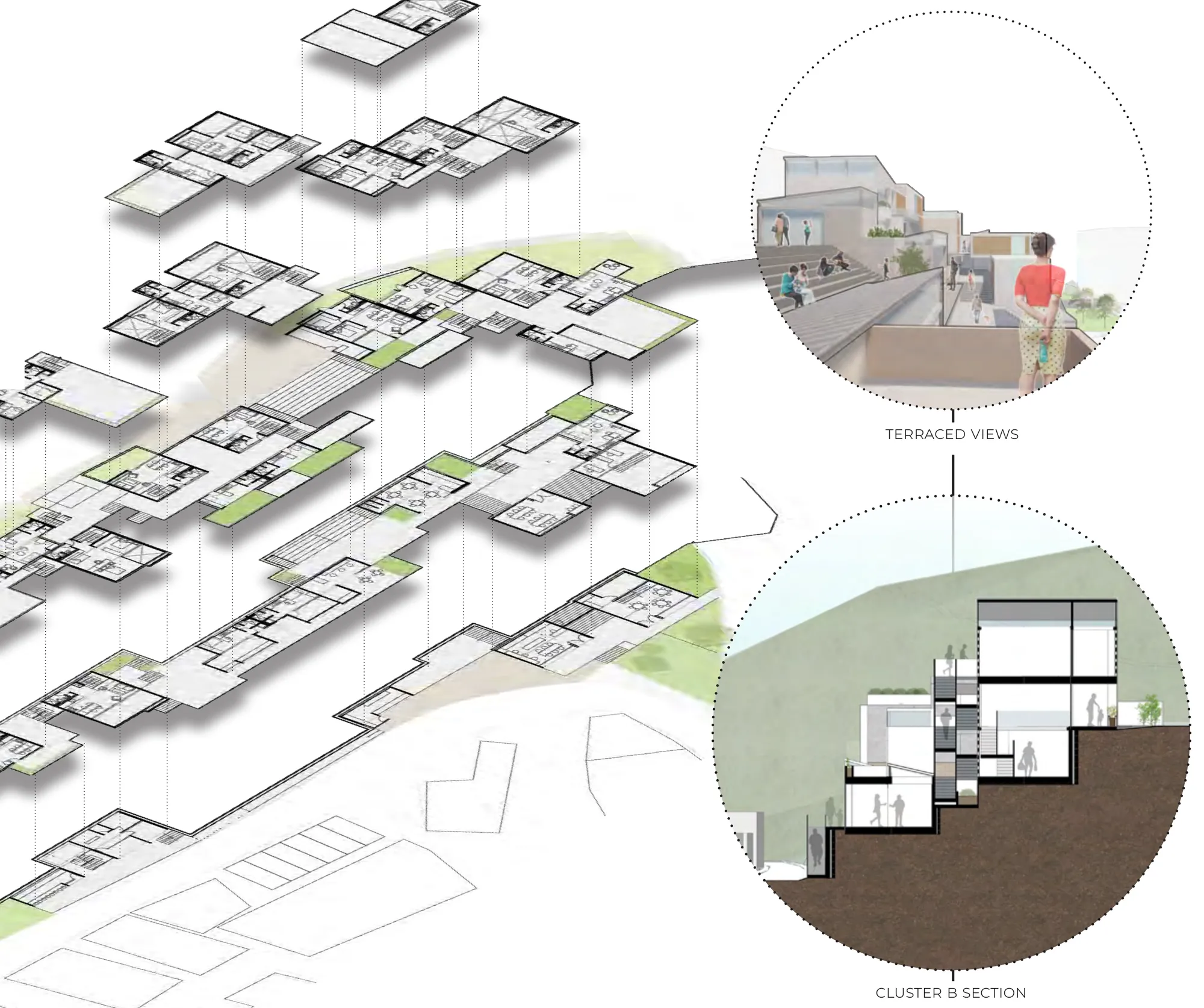

The prototype thus consolidates into context-based housing solutions: adaptive responses to modularity, programmatic variety and facade adaptations; phased unit expansions, self-made transformations and typological variations for diverse living needs; and the integration of public spaces within the community.